
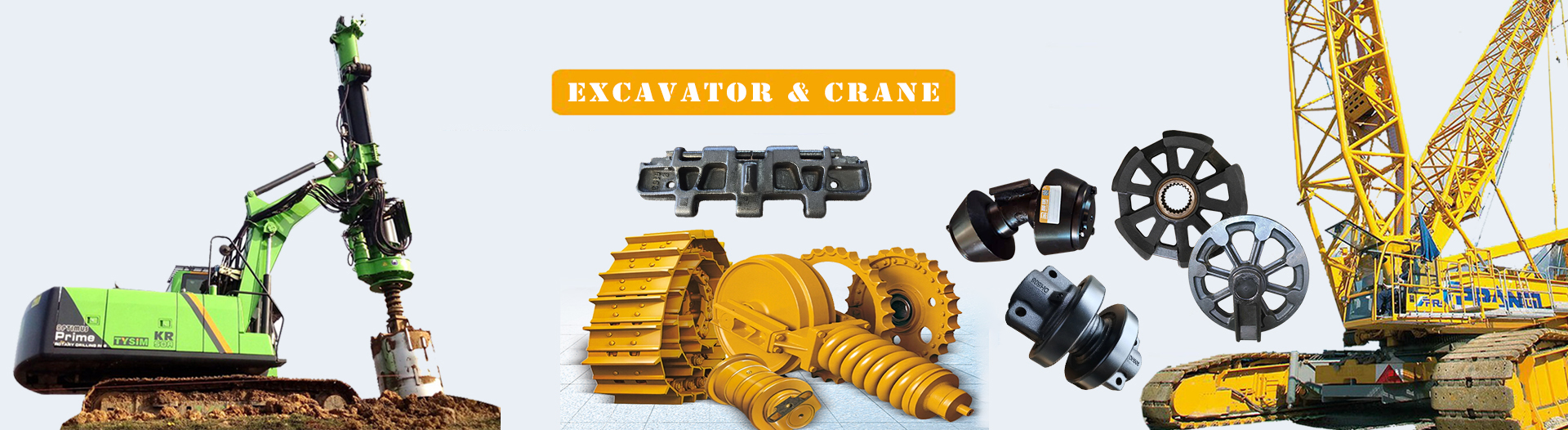
Liebherr LR11000 Lattice Boom Crawler Crane: What the 1,000-Ton Rating Really Demands
Published: July 7, 2026 · By PartsCrane
The Liebherr LR 11000 is a 1,000 to 1,200-ton capacity lattice boom crawler crane built for heavy-duty industrial, infrastructure, and wind power projects. It fills the slot between the LR1750 (750 t) and the LR11350 (1,350 t) — and if you've ever watched one work a wind farm site in mountain terrain, you'd see immediately that the undercarriage is where most of the wear happens.
At full configuration — machine, boom, ballast — the whole assembly weighs around 1,032 tonnes. That load never leaves the track shoes. Whether it's lifting a reactor vessel at a refinery, assembling a wind tower nacelle, or placing a bridge girder over a live waterway, the ground underneath is rarely perfect. Soft mountain slopes in Switzerland, muddy riverbanks in Germany, tight paved yards in Romania — each one stresses the undercarriage in a different way.
The track shoes, rollers, idlers, and sprockets are what keep the machine moving between lifts — and what fails first when maintenance slips. That's what this guide covers.
| For reference: Per Liebherr's official product page, the LR11000 achieves a maximum load moment of 15,171 tm and a lifting height of up to 220 m. The European Association of Abnormal Road Transport and Mobile Cranes (ESTA) classifies any machine above 500 t as "super heavy lift" equipment — meaning ground bearing assessments are mandatory before deployment. That classification is exactly why the LR11000 runs such wide tracks. |
LR11000 Specifications at a Glance
Numbers from Liebherr's published technical data — worth keeping handy when sourcing parts or planning a ground assessment.
| Parameter | Value |
|---|---|
| Rated Lifting Capacity | 1,000 t at 11 m radius |
| Main Boom Range | 8 m – 168 m (modular lattice sections) |
| Derrick Boom | 30 m – 42 m |
| Max Lifting Height | 220 m (main boom + luffing jib) |
| Max Working Radius | 184 m |
| Max Load Moment | 15,171 tm |
| Engine Output | 505 kW — Liebherr diesel |
| Base Machine Weight | approx. 242 t |
| Full Config Weight (with ballast) | approx. 1,032 t |
| Travel Speed | 1.36 km/h |
Source: Liebherr LR11000 official product page.

Why the Undercarriage Takes the Hardest Hit
Think about a typical 100-ton crawler crane: prepared ground, short travel distances, 600–800 mm track shoes. On the LR11000, track shoes run 2,000–2,400 mm wide — roughly the width of a small car — and the full machine weight of ~1,032 t sits on them constantly. You can't just scale up from smaller machines and expect the same wear patterns.
The V-Frame adjustable counterweight is clever engineering, but it creates a maintenance headache: as the counterweight radius shifts during a lift, the load distribution across the crawler changes in real time. A track shoe that handles a static 1,000-ton load just fine can develop fatigue cracks under that kind of cyclic stress — the kind that shows up at the bolt holes first, usually around 800–1,000 hours on a soft-ground site.
Then there's the CAN bus-controlled tension system. On a conventional crawler, the idler sits at a fixed spring preload — set it and forget it. On the LR11000, track tension adjusts automatically to compensate for chassis flex as the V-Frame extends. Smart system, but it means the idler and its bearings absorb variable loads all day rather than sitting at a steady preload. They wear on a fatigue cycle, not a wear cycle. Fixed-hour replacement schedules miss that completely.
The Four Components Worth Watching Closely
Track Shoes
At 2,000–2,400 mm wide, these aren't off-the-shelf parts. Production needs high-alloy steel — 35SiMn or equivalent — with heat treatment that achieves hardness depth all the way through, not just at the surface. The bolt hole pattern has to match OEM spec to the millimetre; 2 mm off on bolt pitch and you'll see fretting at the link connection within a few hundred hours. On a mountain wind farm site, that timeline gets shorter.
Time to replace: grouser bar worn below 10 mm · cracking visible at bolt holes · shoe plate visibly warped when the belt lies flat
Bottom Rollers
Forged 42CrMo, quench-and-temper treated, dual-seal setup — copper sleeve plus floating oil seal. The floating seal is where things go wrong. Once it starts weeping, grit gets into the roller bore and the shaft wears out faster than the tread does. By the time you notice the tread wear, the shaft is already gone. Check the seal face at every service, not just when something sounds wrong.
Time to replace: oil weeping at the seal face · lateral play you can feel by hand · uneven tread wear across the roller width
Idler & Tensioning System
As mentioned above — this idler lives a harder life than most. The CAN bus tension system is great for stability, but it means the idler bearing accumulates fatigue cycles rather than steady wear. Check bearing clearance at every major service. If you're running a fixed 2,000-hour replacement schedule carried over from another machine, throw it out — it doesn't apply here.
Time to replace: bearing noise under load · visible shaft scoring · tension system losing pressure between adjustments
Drive Sprocket
Integral forging, deep tooth-surface quench. The thing to watch isn't tooth wear — it's pitch mismatch. Track links wear and stretch over time, so the pitch increases. Once the gap between link pitch and sprocket pitch hits about 1.5%, the engagement turns destructive fast. Replace the sprocket and track links together. Replacing one without the other is a false economy that costs more in the long run.
Time to replace: pitch mismatch confirmed · tooth root cracking · engagement noise under load — always replace with the track links, not separately
How the Job Site Changes What Wears Out First
Same machine, very different wear patterns depending on where it's working.
| Application | Ground | What Wears Fastest |
|---|---|---|
| Wind farm Mountain terrain | Muddy slopes, uneven | Track shoe fatigue cracks, idler cyclic loading |
| Petrochemical / refinery Confined yards | Hard concrete, limited travel | Bolt hole stress, sprocket pitch mismatch |
| Bridge / infrastructure Riverbank work | Soft bank, gravel mix | Bottom roller seal contamination |
| Port / heavy industrial Salt air, humidity | Paved, corrosive | Surface corrosion on shoes, seal degradation |
Getting Parts for the LR11000 — What to Actually Check
The LR11000 is not a high-volume machine. Global fleet numbers are in the hundreds, not thousands, so OEM lead times can stretch — and a full set of 2,400 mm track shoes for a lattice boom crawler crane at this capacity is a significant procurement. Aftermarket supply exists, but the quality gap between suppliers is wider here than on standard excavator undercarriage.
Four things to verify before placing an order:
Material certificate — steel grade and heat treatment spec in writing, not a verbal assurance
Hardness depth on the grouser bar — a measured value, not a catalogue claim
Supply history for this specific model — not a generic wide-shoe adaptation from another machine
Warranty terms — replacement unit or repair credit, and what counts as a qualifying failure
PartsCrane has manufactured crawler crane undercarriage parts since 2000, with documented supply to LR11000 operators across Southeast Asia, the Middle East, and Europe. Track shoes, bottom rollers, top rollers, idlers, and sprockets — all carry a 1-year free replacement warranty. Quality failure under normal working conditions: we ship a replacement unit, not a repair kit.
Need undercarriage parts for the Liebherr LR11000? WhatsApp — Get a QuoteSend your machine serial number · Replies within 2 hours |
Frequently Asked Questions
What type of crane is the Liebherr LR11000?A lattice boom crawler crane rated at 1,000 to 1,200 tons, with a modular boom system from 8 m to 168 m. Liebherr built it for heavy industrial, infrastructure, and wind power work — the jobs where you need serious capacity but still have to move the machine between picks on ground that isn't always cooperative. |
What track shoe width does the LR11000 use?2,000 mm to 2,400 mm depending on configuration and site conditions. That width is there to distribute ~1,032 t of full-configuration weight within the ground bearing pressure limits that ESTA requires for super heavy lift equipment. It's not something you swap out for a narrower shoe without a proper ground assessment first. |
When should LR11000 track shoes be replaced?Go by condition, not by hours. Grouser bar below 10 mm — replace. Cracking at the bolt holes — replace. Shoe plate visibly warped when the belt is laid flat — replace. On a soft mountain site, you might hit those thresholds at 800 hours. On a paved refinery yard, the same shoes might last twice as long. |
How does the LR11000 differ from the LR1750?Both are lattice boom crawler cranes, but the LR11000 adds the V-Frame adjustable counterweight and CAN bus-controlled track tension — neither present on the LR1750 — which changes how the undercarriage loads and wears in service. You can't apply LR1750 maintenance intervals to an LR11000 and expect the same results. |
Can you use aftermarket track shoes on the LR11000?Yes — but get the material certificate before you commit. Verify bolt pattern, shoe width, pitch, and heat treatment spec against the OEM drawing. Ask whether the supplier has actually made shoes for this model before, or whether they're adapting something from a different machine. On a crane carrying 1,000 tons, that distinction matters. |
| Trademark notice: Liebherr, LR11000, LR1750, LR11350 and associated model names are trademarks of Liebherr-International AG, referenced here solely to identify product compatibility. Parts supplied by PartsCrane / Quanzhou Shunqi Construction Machinery Parts Co., Ltd., Quanzhou, Fujian, China. Not manufactured by or affiliated with Liebherr. |