
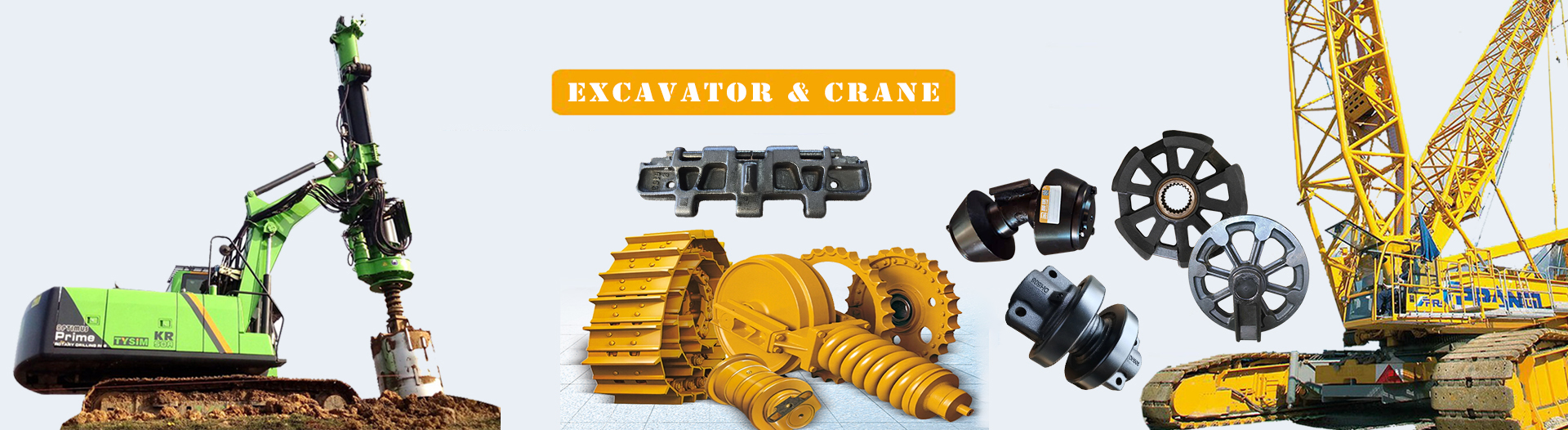
Fault analysis of crawler crane running away
Solving Crawler Crane Tracking Deviation: A Case Study in Real Field Diagnostics
The most frustrating field issue a mechanic could face is probably "tracking deviation"—a crawler crane’s restlessness to relentlessly drift to one side as it moves. When this happens in the field, you are not going to be able to pull out your lab test stands and precision measurement instruments.
In order to effectively diagnose this mystery, a systematic, step-by-step process of elimination is necessary.
Case in Point: In the example below, we investigate a real situation in which a crane displayed a very specific symptom—it slanted heavily to the right only when moving forward at maximum speed, but it drove dead straight backwards.

Step 1: Exclude the Under-Carriage Mechanical Mechanics
The travel system of a crawler crane is a fascinating dance between mechanical components (sprockets, idlers, track shoes, carrier rollers, and track rollers) and hydraulic drives. The golden rule of all maintenance applies here: start with the easiest mechanical components first.
The mechanical part of the inspection for tracking problems consists of checking two critical alignments:
Is the left and right track frame absolutely parallel to each other?
Do the center axes of the drive sprocket, front idler, carrier rollers, and track rollers perfectly coincide?
In case any of these adjustments are incorrect, the machine will drift. However, a purely mechanical misalignment will cause the crane to veer in both forward and reverse. Because our problem machine was slipping only on forward travel, we safely eliminated the mechanical structure from our symmetry of suspects and moved on to the hydraulics.
Step 2: Follow the Hydraulic Line Circuit and Suspects
When the operator presses the travel joystick, pilot oil shifts the main control valve spool and releases the parking brake simultaneously. This allows the high-pressure hydraulic oil to flow into the travel motor and turn the final drive.
A speed imbalance can be caused by a defect in the joystick, main control valve, travel motor, or brake valve. Based on historical repair data, we sorted our troubleshooting order from the highest to lowest failure frequency:
1. The Travel Motor (Suspect #1)
Internal bypass or volumetric wear inside a motor decreases its efficiency, which slows down that specific side. If the right-side motor was fully bypassing internally, it would cause the crane to veer to the right in both forward and reverse.
Field Test: We unplugged the case drain line from the right travel motor and performed a travel test. A normal, minimal trickle of oil came out, confirming that the internal seals were as tight as could be. The motor was cleared.
2. The Joystick Pilot Control Valve (Suspect #2)
A worn joystick’s internal spool will fail to deliver enough pilot pressure to fully shift the main control valve. As a result, the travel motor becomes oil-starved. Since forward and reverse travel are operated by two totally different spools within the joystick, a directional malfunction is possible.
Field Test: We switched the forward and reverse pilot lines in the field. The crane continued to veer to the right only when moving forward, so the joystick was eliminated from suspicion.
3. The Main Control Valve (Suspect #3)
Spool sticking or internal leakage from contaminated hydraulics can decrease oil flow. Since forward and reverse travel for one side are handled by the same internal spool of the main valve, an internal leakage failure would typically affect both directions.
Field Test: To check for a physically stuck spool, we swapped the main high-pressure lines (the output from the left valve went to the right motor, and vice versa). The offset symptoms remained exactly the same, which cleared the main control valve.
Step 3: Finding the Malfeasor – The Brake Valve
The counterbalance/brake valve is essential for critical safety functions, including over-speed protection during descent and hydraulic braking. If the valve spool is blocked internally by tiny particles, or if a small orifice is clogged, the valve will not open fully. This creates an extremely severe restriction, choking off fluid flow and causing a huge pressure drop on one side.
To prove this, we tapped pressure gauges into the appliance ports (P-ports) of both the left-travel and right-travel circuits. The results provided the smoking gun:
| Travel Direction | Low Throttle Behavior | High Throttle Behavior |
|---|---|---|
| Reverse Travel | Pressures balanced; machine runs straight. | Pressures balanced; tracks straight. |
| Forward Travel | Small, negligible pressure changes. | The pressure on the right side shot up over a dozen MPa more than the left side, and was very wobbly. |
At low throttle, the small volume of oil passed through the restriction easily. At full throttle, however, the enormous bulk of oil pounded against the partially closed valve, resulting in massive flow losses and violent pressure spikes.
The Final Settlement
When we disassembled the brake valve assembly on the bench, a small piece of contamination was found tightly lodged inside the forward travel damping orifice.
After being thoroughly cleaned with solvent and cleared with clear compressed air, the valve was reinstalled. The crane's tracking error disappeared immediately, and the machine returned to full operational order.
Contact Us | Wechat 
|