
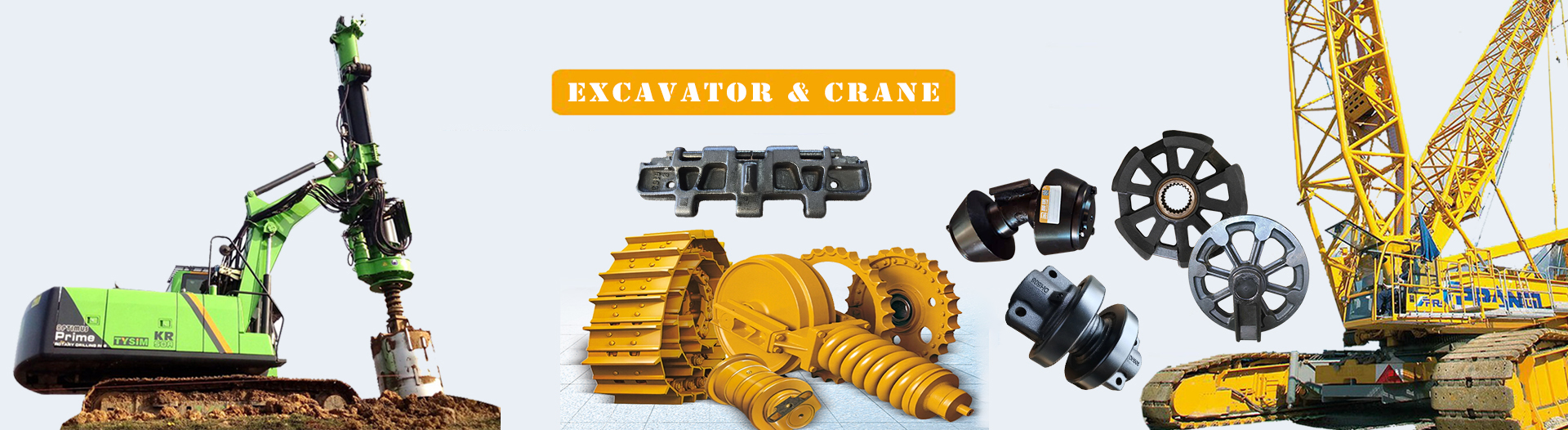
Fault analysis of crawler crane running away
Crawler crane walking and running deviation is a common fault of crawler crane, resulting in many reasons for walking and running deviation crawler crane walking, especially on the site, because of the lack of measuring instruments and test devices, it is difficult to analyze. The following combined with examples of crawler crane runaway causes and judgment methods are introduced. The fault phenomenon of a crawler crane is running to the right when moving forward, not running backward, and running serious when the throttle. Crawler crane walking system is mainly composed of mechanical parts (including driving wheel, guide wheel, sprocket, support wheel, crawler) and hydraulic driving parts. Maintenance, should be in line with the principle of first easy, first analyze the mechanical part. The mechanical part mainly checks two aspects, one is whether the two tracks are parallel; The second is whether the center line of the driving wheel, guiding wheel, supporting sprocket and supporting heavy wheel coincide. Either side of the two has a problem, will cause walking deviation, but the phenomenon should be forward and backward running, and the car is only forward running deviation, so it can be determined that the fault is not caused by the mechanical part. At this point, the hydraulic part needs to be analyzed. When pushing the control handle 5, the control handle provides pressure oil to brake 1, open the brake, at the same time, the control handle provides pressure oil to the main valve 4, to promote the main valve spool action, the main valve provides pressure oil to the motor 2, the motor runs, so as to drive the walking reducer operation, to achieve the walking crawler crane. The brake valve plays a parking hydraulic brake, downhill speed limit and other functions. From the point of view of the whole walking hydraulic system, the failure of any of the components such as the motor, brake valve, main valve and control handle will cause walking deviation. According to experience, the order of failure rate from high to low is motor, control handle, main valve and brake valve, which are analyzed in order below. The fault of the motor is mainly manifested as large internal discharge. If the internal discharge of the right motor is large, the volumetric efficiency is reduced, the speed of the right motor will be lower than that of the left motor, and this situation will cause both forward and backward running to the right, so it can be determined that it is not the fault of the motor. In order to confirm this decision, the oil drain port of the right motor was opened and the walking test was conducted. It was found that the hydraulic oil slowly spilled from the oil drain port, which proved that the internal drainage was normal and the motor was confirmed to have no fault. The common failure of the control handle is that the internal discharge of the valve is large, the pilot pressure provided to the main valve is low, resulting in the main valve is not fully opened, and the hydraulic oil flow to the motor is small and causes deviation. Forward and backward are controlled by two independent spool in the control handle, the control handle controls forward and backward of the two oil outlet exchange, if there is a backward deviation, no deviation when moving forward, it proves that the control handle is faulty. After the replacement test, it was found that it was still running to the right when moving forward and not running backward, indicating that it was not the problem of the control handle. The common failure of the main valve is large leakage in the valve, resulting in large flow loss; Or the hydraulic system is not clean, resulting in spool stuck, incomplete valve opening, small flow. Because forward and backward are completed by the same spool in the main valve, if the leakage in the valve is large, both forward and backward should be deviated, so it can be determined that the failure possibility of large leakage in the main valve is small. In order to analyze whether the main valve spool stuck, replace the pipeline, will control the main valve oil outlet of the left motor to the right motor, control the main valve oil outlet of the right motor to the left motor, if there is a problem with the main valve, deviation direction will change, walking test after the fault phenomenon does not change, can prove that there is no problem with the main valve. The common failure of brake valve is large leakage or spool action is not in place. If the amount of leakage in the valve is large, the forward and backward should run off, and the failure possibility of large leakage in the valve is small. If the spool is stuck by debris or the valve orifice is blocked, resulting in spool action is not in place, the valve opening is small, the hydraulic oil through the small amount, and cause deviation, large throttle pressure and flow loss, deviation will be serious. Therefore, a pressure gauge is connected to the oil inlet (P port) of the left and right main valves for walking test. It is found that the left and right pressures are basically the same when retreating. But forward if the small throttle, left and right pressure difference is not big; If the throttle is large, the pressure on the right is several mpa higher than that on the left, which indicates that the spool action of the brake valve to control the direction of advance is not in place, and the oil is not smooth. When the hydraulic oil flow is small, the pressure and flow loss is small, and the pressure and flow loss is large when the throttle is large, so that the forward deviation to the right is caused, the backward deviation is not caused, and the serious fault phenomenon when the throttle deviation. Disassembly and inspection of the brake valve, it is found that the throttle orifice controlling the forward direction is blocked by debris, and the fault disappears immediately after cleaning. From the above analysis, we can know that for the crawler crane walking deviation fault, there are many reasons, we can consider all possible factors, and then analyze and determine item by item, and confirm by measurement and test, item by item exclusion, in order to find the real reason.
Contact Us | Wechat 
|